
01 / HOME
Care and time together
Who we live with, care for and rely on, and whether there is time left for them.
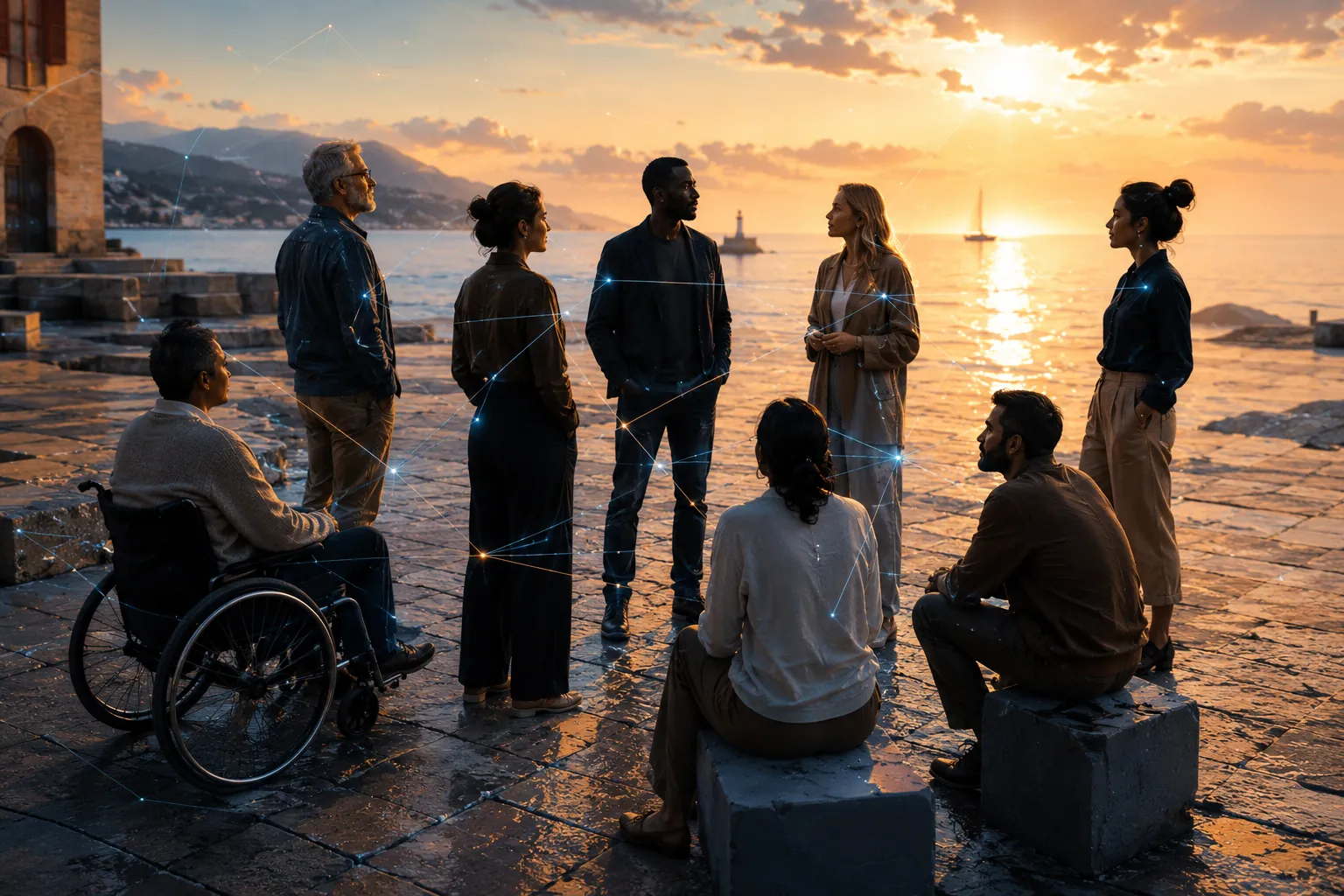
Malta and Gozo
thinkpeople.you looks at how people in Malta and Gozo live, work, care and belong together, and what that means for the life we share.
The idea
Most measures treat wellbeing as something each person holds alone: income, health, satisfaction. Those matter. But a good life is also made between people.
It shows in the time a family has together, the trust between colleagues, the neighbour who checks in, and the fairness people expect from their institutions. We look at wellbeing in those relationships, and at who is left outside them.


What we observe
01 / HOME
Who we live with, care for and rely on, and whether there is time left for them.
02 / WORK
Colleagues, management, hours and pressure: what work gives to a life, and what it takes from it.
03 / COMMUNITY
Neighbours, parish, clubs and voluntary life: the ties that hold a locality together.
04 / PUBLIC LIFE
How people experience services and institutions, and whether they feel treated fairly.
A different national conversation
Not only: “How well off are people?”
Also: “Who do people have, and who is there for them?”
Home, work, community and public life pull on one another. Long hours become less time for care; a thinner local life becomes lonelier later years. We read the ties between them, not only what happens inside each.

The evidence so far
People in Malta rate their lives and their relationships highly. They trust others less than the EU average, time is the satisfaction that scores lowest, and the strains gather in later life.
Latest comparisons
Our release · Eurostat 2025
7.6/10
Overall life satisfaction in Malta.
EU average 7.2
Eurostat, ilc_pw01, 2025.
Our release · Eurostat 2025
5.0/10
Trust in other people in Malta.
EU average 5.8
Eurostat, ilc_pw03, 2025.
Our release · Eurostat 2025
19.4%
of people in Malta at risk of poverty or social exclusion.
EU average 20.9%
Eurostat, ilc_peps01n, 2025.
EU-OSHA · 2024
75%
of workplaces in Malta train staff to use digital technologies.
EU average 42%
EU-OSHA, ESENER 2024. Establishments with five or more workers.
NSO Malta · 2023
8.6/10
Satisfaction with personal relationships.
Highest among people aged 65 and over, at 8.8.
93.5%
would receive help from family, friends, colleagues or others if they needed it.
Material or non-material help.
7.7/10
Job satisfaction.
Among people in work.
6.7/10
Satisfaction with time use.
The lowest of all the satisfaction scores measured.
Source: NSO Malta, EU-SILC 2023: Well-being, Social and Health Indicators, News Release 048/2025 (17 March 2025). Persons aged 16 and over in private households.
NSO Malta · 2022–2023
33.3%
of people aged 65 and over at risk of poverty or social exclusion in 2022.
Up from 28.5% in 2020.
12.3%
of people aged 65 and over facing material and social deprivation in 2022, which includes meeting friends or family.
Up from 10.0% in 2020.
5.3%
of people aged 65 and over felt lonely most of the time in 2023.
Among people at risk of poverty or social exclusion: 5.0%.
7.3/10
life satisfaction among people aged 65 and over in 2023.
The lowest of any age group.
Sources: NSO Malta datasets DF_LIVCOND_AROPE and DF_LIVCOND_MSD (2022), CC BY 4.0; NSO Malta, News Release 048/2025 (2023 figures).
Every figure is shown as its publisher released it, with its year. Our own findings join this page only once a release has been approved.
Our family
thinkpeople.you began as the wellbeing layer of SHaiPING Malta. It now stands as its own ThinkPeople Nexus initiative, with its own questions, its own governance and its own approvals.
The two stay linked. SHaiPING asks how people can reach the skills and work their future requires. thinkpeople.you asks whether that future leaves room to live well together.
Shared public evidence. Separate approvals.
How we work
NSO Malta, Eurostat, the EU Joint Research Centre, Eurofound and the OECD, each credited with its period.
Collecting or drafting never publishes anything. Findings go public only by deliberate decision.
Averages can hide whose experience is missing. We say who a figure covers, and who it does not.
Evidence is stored in the European Union and kept as collected.

Take part
Participation opens by invitation first. Register your interest and tell us how you would like to take part. We will always say what is shared, with whom, and what is published.